
Dismantling Forst: A Series of Critiques on Justification, Tolerance, and Human Rights
Keywords:
right to justification, tolerance, human rights, critical theory, decolonial critiqueAbstract
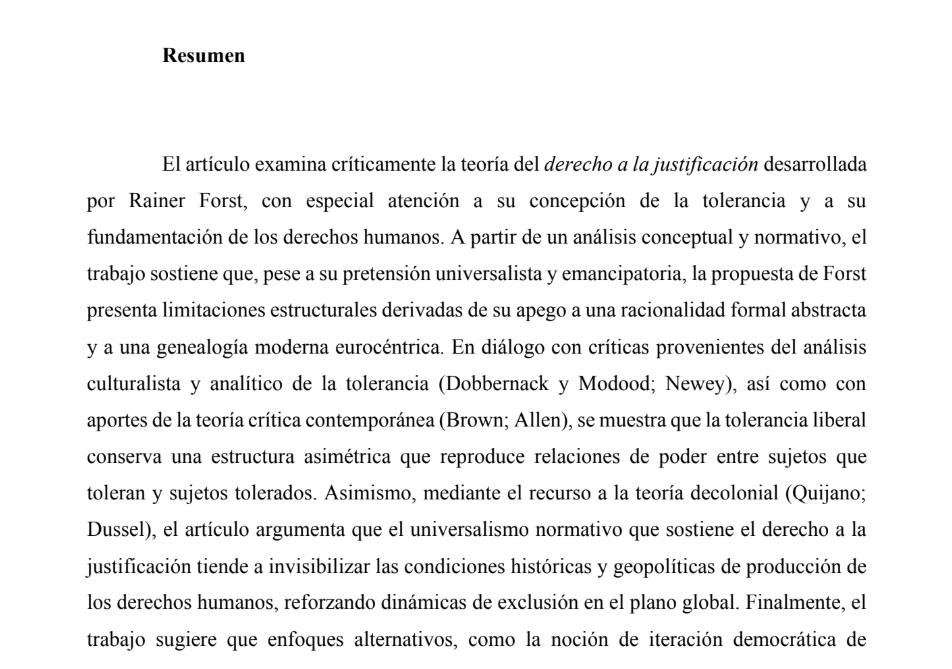
This article critically examines Rainer Forst’s theory of the right to justification, focusing on its account of tolerance and its normative grounding of human rights. It argues that, despite its emancipatory and universalist aspirations, Forst’s proposal is constrained by an abstract formal rationality and by a Eurocentric genealogy rooted in modern Western thought. Drawing on culturalist and analytical critiques of tolerance (Dobbernack and Modood; Newey), as well as contributions from contemporary critical theory (Brown; Allen), the paper shows that liberal tolerance retains an asymmetrical structure that reproduces power
relations between tolerating and tolerated subjects. Furthermore, engaging with decolonial theory (Quijano; Dussel), the article contends that the universalism underlying the right to justification tends to obscure the historical and geopolitical conditions shaping human rights, thereby reinforcing exclusionary dynamics at the global level. Finally, the paper suggests that alternative approaches, such as Benhabib’s notion of democratic iteration, provide a less foundationalist and more context-sensitive framework for rethinking human rights.
Downloads