
The Legal Construction of the Mental Health Category: The Impact of Formal Changes on Institutions
Keywords:
mental health, asylum, categorization, symbolic violence, lawAbstract
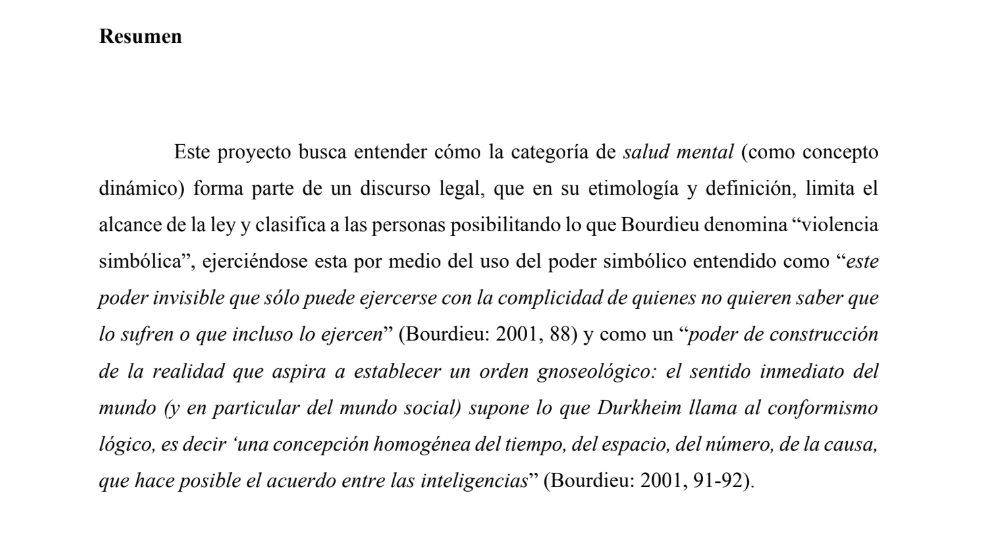
This project seeks to understand how the category of mental health (as a dynamic concept) is part of a legal discourse, which in its etymology and definition, limits the scope of the law and classifies people, enabling what Bourdieu calls “symbolic violence”, exercised through the use of symbolic power understood as “this invisible power that can only be exercised with the complicity of those who do not want to know that they suffer from it or even exercise it” (Bourdieu: 2001, 88) and as a “power of construction of reality that aspires to establish a gnoseological order: the immediate meaning of the world (and in particular of the social world) supposes what Durkheim calls logical conformism, that is to say ‘a homogeneous conception of time, space, number, cause, which makes agreement between intelligences possible" (Bourdieu: 2001, 91-92). Tensions are perceived between the medical and legal fields, which are intended to be highlighted, since it is argued that both are in a constant struggle to impose their definitions and construct different concepts, which could impact a society's common sense, constructing realities and meanings. Therefore, this work focuses on the analysis of regulations in the field of mental health and on institutional changes in the Argentine judicial and public health systems, recognizing these regulations as the expression of a formal paradigm shift that has possibly impacted these institutions.
Downloads