
Contributions of legal sociology to understanding productive development: the case of industrial clusters in Buenos Aires Province
Keywords:
legal sociology, productive development, state, industrial parks, inequialityAbstract
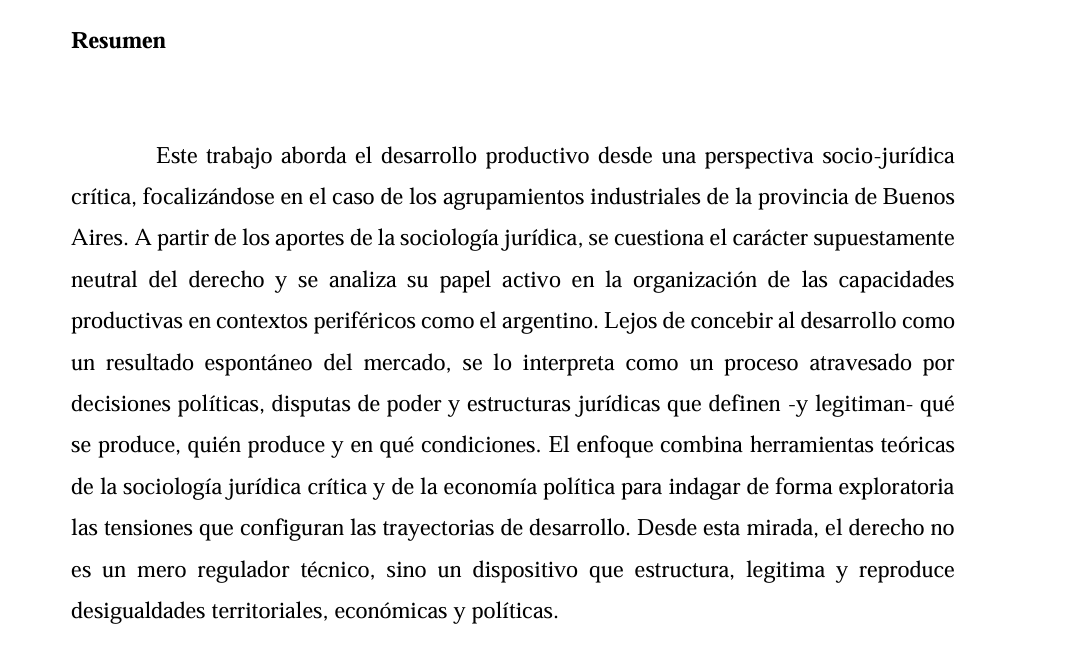
This paper addresses productive development from a critical socio-legal perspective, focusing on the case of industrial clusters in the province of Buenos Aires. Drawing on contributions from legal sociology, it questions the supposedly neutral nature of law and analyzes its active role in organizing productive capacities in peripheral contexts such as Argentina. Far from conceiving development as a spontaneous outcome of the market, it interprets it as a process influenced by political decisions, power struggles, and legal structures that define—and legitimize—what is produced, who produces, and under what conditions. The approach combines theoretical tools from critical legal sociology and political economy to explore, in an exploratory manner, the tensions that shape development trajectories. From this perspective, law is not merely a technical regulator, but a mechanism that structures, legitimizes, and reproduces territorial, economic, and political inequalities.
Downloads